
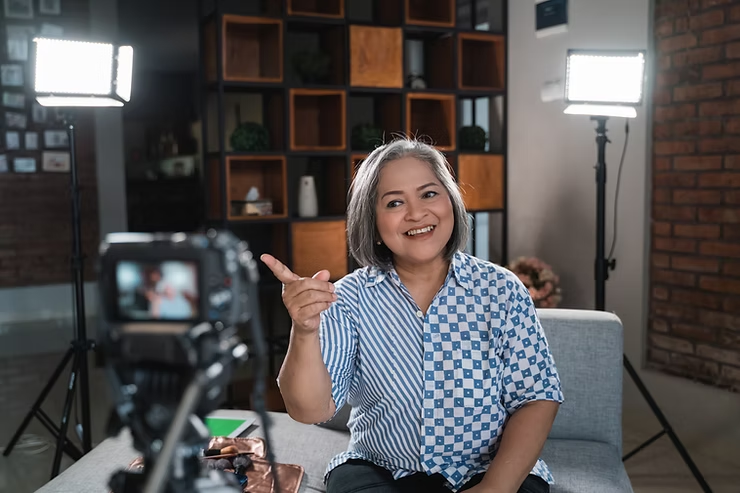
Most corporate video shoots have one thing in common: time is limited.
The senior team may only be available for a few hours. Customer interviews might need to happen during a busy event. The office may only be suitable for filming on one particular day. For B2B marketing teams, the challenge is not just to “get a video made”, but to make sure the filming time produces useful assets for the website, sales team, LinkedIn, internal communications and future campaigns.
At Headroom Films, we help businesses plan focused, efficient filming days that make good use of everyone’s time. That might mean a case study video, a customer testimonial film, event video production, leadership interviews, company story content or a mix of several assets from the same shoot.
Here is how to make limited filming time work harder.
1. Start With The Business Outcome
A productive filming day starts before the camera comes out.
The first question should not be “what do we want to film?” It should be “what does this video need to help with?”
For example, a B2B team might need to:
- Build trust with prospective clients
- Support sales conversations
- Capture customer stories at an event
- Explain a product or service more clearly
- Show the people behind the business
- Create short clips for LinkedIn and email campaigns
- Produce internal communications or recruitment content
Once the outcome is clear, the filming plan becomes much easier. We can prioritise the right people, the right questions, the right locations and the right supporting footage.
For a case study video, the priority may be the customer interview. For an event video, it may be capturing attendees, speakers, audience reactions and short customer comments. For a company film, the priority may be leadership interviews, team interaction and the working environment.
Clear objectives stop the day becoming a collection of random footage. They help turn a limited filming window into a focused production plan.
2. Prioritise Interviews Before The Shoot
Interviews are often the most valuable part of a corporate video shoot, especially for case study videos, customer testimonials and leadership content.
They are also where time can be lost if the planning is weak.
Before filming, it helps to agree:
- Who needs to be interviewed
- What each person should cover
- Which answers are essential
- Which messages should not be repeated by every speaker
- Whether the tone should be formal, conversational or more documentary-style
- How the interview content will be used after the shoot
This does not mean giving people a script. In most cases, scripted answers feel less natural. The better approach is to prepare clear themes and questions so the interviewee understands the direction, while still speaking in their own words.
For B2B case studies, the best answers often come from asking about the problem, the decision process, the working relationship and what changed after the project. For customer testimonial films, the aim is usually to capture a natural endorsement that feels credible rather than overproduced.
Good interview planning saves time on the day and usually produces stronger, more usable answers.
3. Build The Filming Day Around Availability
In corporate video production, the schedule needs to work around the business, not the other way around.
Senior people may only have a short window. Customers may be travelling in for an event. Teams may be working around meetings, calls or live client work. A good filming plan takes this into account.
For example, it may make sense to film leadership interviews first, then use the rest of the day for office b-roll, team activity, product shots or cutaway footage. At an event, it may be better to capture customer comments during natural breaks rather than trying to pull people away during key sessions.
The schedule should also reduce unnecessary movement. Grouping interviews in one location, planning room changes properly and knowing where b-roll will be captured can make a big difference to the amount of usable footage from one day.
A well-planned shoot should feel calm, not disruptive.
4. Capture More Than One Asset From The Same Filming Session
One of the best ways to make limited filming time more valuable is to plan for multiple outputs from the start.
A single filming day can often support:
- A main case study video
- Short customer testimonial clips
- Website video content
- LinkedIn edits
- Sales enablement clips
- Internal communications
- Event recap content
- Speaker or keynote highlights
- Future b-roll for later campaigns
This only works properly if it is planned in advance.
For example, if a client wants both a main case study video and shorter social clips, we can shape the interviews so there are clean, self-contained answers that work as standalone edits. If an event is being filmed, we can plan time for customer story capture alongside the main event coverage.
This is where a limited filming day can become much more commercially useful. The aim is not just to make one finished video. The aim is to capture material that can support marketing and sales activity for weeks or months afterwards.
5. Use B-Roll To Support The Story
B-roll is the supporting footage that gives a video context, pace and visual interest. It can include team interaction, office scenes, product use, event spaces, audience reactions, detail shots, working processes or informal moments between people.
In case study videos and testimonials, b-roll helps avoid a video becoming too interview-heavy. It gives the editor the material needed to support what the speaker is saying.
For example:
- A customer talks about collaboration, while the edit shows people working together
- A founder explains the company’s process, while the edit shows the team in action
- A client discusses an event, while the edit shows audience engagement and the venue
- A product or platform is mentioned, while the edit shows relevant usage or interface shots
B-roll also gives flexibility in post production. If a section of an interview needs tightening, supporting footage can help the edit feel natural. If future videos are needed, a strong b-roll library can reduce the need for additional filming.
This is why it is worth protecting time for b-roll, even on a tight schedule.
6. Plan For Website, Sales And Social Use
A corporate video does not usually live in one place.
A main edit might sit on a website or landing page. Shorter clips might be used on LinkedIn. Sales teams may want specific customer quotes. Internal teams may want a version for presentations or onboarding.
Planning these uses before the shoot helps us capture the right material.
For example, a website video may need a clear beginning, middle and end. A LinkedIn clip may need a strong opening line that works without much context. A sales clip may need a specific customer answer that addresses a common objection. An internal version may need a more detailed explanation than a public-facing edit.
The more we know before filming, the easier it is to capture footage that can be shaped into different formats later.
This is especially useful for B2B teams with limited access to customers, senior leaders or event attendees. When the right people are already in the room, it makes sense to plan the shoot properly and capture as much useful material as possible.
7. Keep The Shoot Focused, But Leave Room For Natural Moments
A good filming day needs structure, but it should not feel rigid.
Some of the most useful footage comes from natural moments: a genuine conversation, a strong answer in an interview, an audience reaction, a team interaction or a detail that was not obvious during planning.
The role of planning is to make sure the essential content is captured. The role of the production team is also to notice what is happening on the day and capture the moments that make the final video feel more human.
This is particularly important for customer testimonial videos and event filming. The best material often feels honest and unscripted, but it still needs to be captured professionally.
8. Make Post Production Easier Before Filming Begins
Post production is where the footage becomes a finished video, but the quality of the edit depends heavily on the planning.
A focused filming day gives the editor:
- Clear interview answers
- Enough b-roll to support the story
- Clean audio
- Useful cutaways
- Different shot sizes and angles
- Content that can be edited into multiple formats
This makes it easier to produce a polished main video and shorter supporting edits without forcing the footage to do something it was never planned to do.
For clients, this means better use of the original investment. One well-planned shoot can become a main case study film, several short clips, internal content and future marketing material.
How Headroom Films Helps Clients Use Filming Time Efficiently
Headroom Films works with B2B teams that need professional video production without unnecessary complexity. Our work often includes case study videos, customer testimonial films, corporate event coverage, leadership interviews and company story content.
We help clients plan the filming day carefully, agree priorities before the shoot and capture footage that can be used across different channels.
For clients who need a clear scope, our Case Study Packages and Event Video & Photography Packages are designed to make the process easier to plan. For teams trying to build trust with prospects or capture customer stories at events, our Build Trust and Unlock Event Potential pages explain how this type of content can fit into a wider marketing strategy.
You can also browse examples of our video production work or explore Partnership Programmes if you need regular video support across customer stories, testimonials, social shorts or ongoing content.
Limited filming time does not need to limit the value of the final content. With the right planning, one filming day can produce a useful set of video assets for your website, sales team, social channels and future campaigns.
If you are planning a corporate video shoot, customer testimonial, case study video or event filming day, we can help you structure the shoot so the time is used properly.
Leave a Reply