
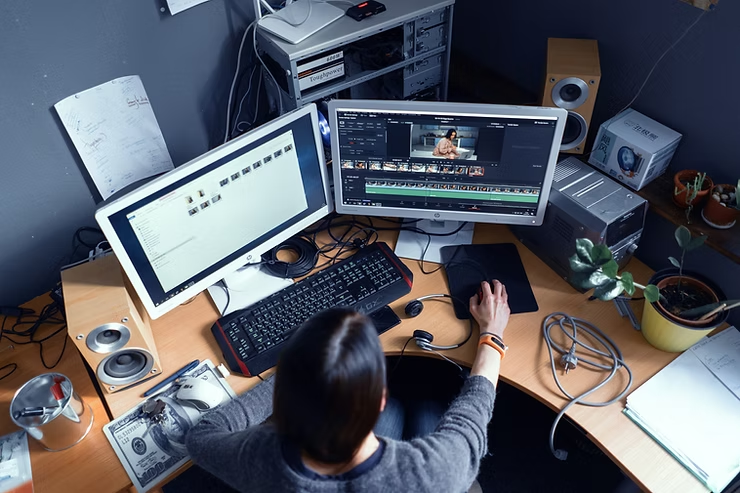
Creating new video takes time, planning and budget, and not every campaign needs to start from nothing. Footage you already have can often be re-edited, reframed and reused for a different audience, a different channel or a different stage of the sales process.
This is worth being practical about rather than strategic. Here is what people actually ask for, what it costs, and what decides whether it works.
What People Usually Want
In practice this is rarely about a dusty archive. Most requests are about footage shot in the last year or two, often with the masters and separate audio still available, which makes the job straightforward.
Three versions come up again and again.
Supporting footage for new interviews. The b-roll from a previous shoot is still accurate, the offices and the product have not changed, and it can sit under interviews filmed now. This is the easiest of the three and often the best value, because b-roll is the part of a shoot that takes the most time to gather.
A short social cut from an existing film. Interviews and supporting footage recut to a minute or less, reframed for vertical, subtitled. The material is already there and the job is selection and pace.
Soundbites only. One strong answer pulled out and cut as a standalone clip. Quick, and usually the highest return per hour of editing.
All three are charged as standard editing days, so the cost is predictable and you can decide whether it is worth it before anything starts.
What Decides Whether It Works
Four things, and they are worth checking before anyone promises an output.
Whether the masters exist. Original files with separate audio tracks give an editor room to work. A compressed export with the mix baked in does not. This is the first question we ask.
Whether there is coverage beyond the original edit. A film is cut to a length, and what survives is roughly what that edit needed. If the shoot was efficient there may be very little spare. If it was generous, there is often a second film sitting in the unused material.
The aspect ratio. Anything framed for a 16:9 player has the subject placed for that crop. Close-ups usually survive a vertical reframe. Wides usually do not. Worth checking before promising anyone a vertical cut.
Whether it has dated. Old branding, an office you have left, a product two versions behind, or a contributor who now works somewhere else. None of this matters internally. All of it matters on a homepage.
Where the Footage Lives
We keep the footage from a shoot for twelve months. Before it is deleted we check whether you want us to hold on to it, and if you would rather keep it yourself we can hand over the masters at any point.
Worth knowing, because it sets a window. Coming back to a shoot within the year is straightforward. Coming back after two or three, when the files may only exist as whatever was delivered at the time, is a different job.
If you are planning to reuse footage regularly, it is worth agreeing early who holds the masters and where.
Customer Interviews Are the Most Reusable Thing You Own
A single interview usually contains several stories. One answer is about the problem the customer had. Another is about how they decided. A third is about what changed afterwards.
Treated as material for one finished film, most of that goes unused. Treated as a set of answers, it becomes a case study video, a short testimonial, three social clips and a piece of sales material.
This is why we record more than the edit needs. The film requires ninety seconds from a contributor and we will take twenty minutes, because the extra answers are what becomes next quarter’s content.
If you already have interviews sitting in an archive, they are the first place to look. There are often stories in there that were never used. If you are planning new customer stories rather than working from an archive, our case study video production packages are built around capturing that material deliberately.
Events Produce the Most Material in the Least Time
An event puts your customers, partners and senior people in one room on one day. That does not happen again all year, and it is why event footage tends to outlast everything else.
At FFECON, the financial crime conference we film for FINTRAIL, the organisers held all the customer interviews until the end of the day so attendees had actually experienced the event they were being asked about. Six interviews, back to back, in the empty theatre once the keynotes had finished. One day on site produced the event film and six standalone customer stories, each usable on its own for months afterwards.
More on how we approach this in our guide to filming corporate events, and in the FFECON project itself.
Re-Editing Around a New Message
Sometimes the footage is fine but the story has moved on. A film built around a product launch can often be rebuilt around customer success, growth, recruitment or a new market, as long as the interview material is broad enough to carry it.
This is the version most dependent on how the original shoot was run. If the interviews only ever answered the campaign brief, there is nothing else in them. If they went wider, there usually is.
Planning It Before the Next Shoot
The easiest repurposing is the kind that was expected. It costs very little on the day and removes most of the constraints above.
Frame for both orientations. We shoot horizontally with the vertical crop in mind, keeping the subject inside a centre column so the same take works on a website and on a phone. Deciding this in advance is free. Deciding afterwards is a compromise.
Interview longer than the film needs. The extra answers are the ones that become the social content and the sales clip.
Shoot b-roll against the story, not as a shopping list. The question is not what to film while we are here, it is what this story would need if it were told three different ways.
Agree the outputs before filming. A website film, a set of social cuts and a sales version are three different edits, and knowing that on the day means the coverage exists for all three.
For Metaview we produced two case study films, one with Deel and one with Cockroach Labs. Both were planned so they could work at two stages at once: as paid advertising on LinkedIn and YouTube, where they reach people who have never heard of the company, and on Metaview’s own case study pages, where they serve prospects already deciding. Same shoot, different jobs, because the requirement was known before anyone set up a camera. See the Metaview case study project.
That was not repurposing. It was planned reuse, which is the same idea done at the right end of the process.
If You Already Have Footage
Send us a link to the masters and tell us what you want out of them. We will say what is realistic before anyone books an editing day, including when the answer is that filming half a day of new material would cost less than forcing old footage into a job it was never shot for.
If you film regularly, an ongoing video production arrangement usually works out better than commissioning each piece separately, partly because the footage accumulates in one place.
Or if you are planning a new shoot and want it to produce more than one thing, that is worth a conversation before the brief is written rather than after. Get in touch.
Recent Posts
Leave a Reply